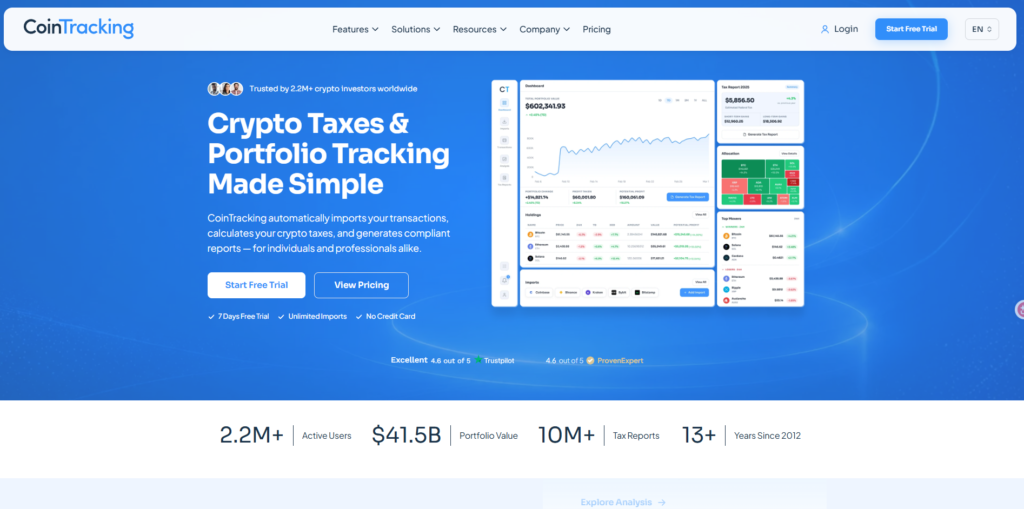
Overall Rating: 9.0 / 10 ⭐⭐⭐⭐
Most Crypto Tax Software Looks Amazing Until You Touch DeFi
That’s the dirty secret nobody talks about.
Almost every crypto tax platform works perfectly when your portfolio looks like this:
Buy Bitcoin.
Hold Bitcoin.
Sell Bitcoin.
Done.
The dashboard looks beautiful.
The tax report appears accurate.
Everyone is happy.
Then reality happens.
You start using crypto the way crypto was actually designed to be used.
You:
- Stake assets
- Farm liquidity pools
- Bridge tokens
- Mint NFTs
- Flip NFTs
- Participate in airdrops
- Use perpetual futures
- Trade on decentralized exchanges
Suddenly the software that promised “automatic crypto taxes” begins struggling.
Transactions disappear.
Transfers become taxable events.
Cost basis calculations break.
Reports stop making sense.
Many investors discover an uncomfortable truth:
Most crypto tax software was built for crypto investors.
Not crypto users.
CoinTracking is one of the few platforms that appears to understand the difference.
After more than a decade operating in the industry, the platform has developed a reputation among serious crypto participants as one of the few tools capable of handling extremely messy transaction histories.
That doesn’t mean it’s perfect.
Far from it.
But if your portfolio resembles a blockchain explorer rather than a brokerage account, CoinTracking becomes a much more interesting option.
Brand Background
CoinTracking launched in 2012.
That timing matters more than most people realize.
Back then:
- DeFi didn’t exist
- NFTs didn’t exist
- Layer 2 networks didn’t exist
- Yield farming didn’t exist
Yet CoinTracking survived long enough to adapt to all of them.
Many competitors entered the market during the 2020–2021 bull run.
CoinTracking was already processing millions of transactions before DeFi became mainstream.
This historical advantage shows up in one specific area:
Transaction complexity.
The platform wasn’t built around simple portfolios.
It evolved alongside crypto itself.
As crypto became more complicated, CoinTracking became more complicated too.
That is both its greatest strength and one of its biggest weaknesses.
Product Deep Dive
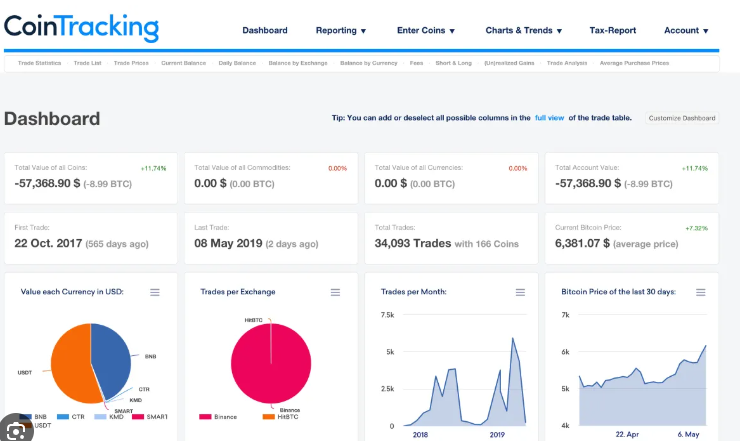
DeFi Transaction Tracking
This is where CoinTracking earns its reputation.
The Problem
DeFi transactions are rarely single transactions.
One click can trigger:
- Swaps
- Liquidity additions
- Reward claims
- Token burns
- Gas fees
- Wrapped assets
A blockchain may record dozens of events.
The user remembers one.
Tax software has to reconcile all of them.
How CoinTracking Solves It
CoinTracking imports blockchain transactions and attempts to categorize them based on transaction type and source.
Users can then review, edit, and reconcile records manually when necessary.
Why This Matters
Many crypto investors want automation.
Serious investors want accuracy.
Those are not always the same thing.
CoinTracking leans heavily toward accuracy.
That approach creates extra work.
But often produces better results.
NFT Tracking
Most investors underestimate how difficult NFT taxes actually are.
The Problem
NFT transactions introduce multiple variables:
- Acquisition costs
- Marketplace fees
- Royalties
- Gas expenses
- Cross-chain activity
Tracking these manually becomes exhausting.
How CoinTracking Solves It
The platform supports NFT-related transaction tracking across supported wallets and chains.
Users can identify purchases, sales, transfers, and associated costs.
Why This Matters
NFT traders often generate hundreds of transactions from relatively few purchases.
Traditional portfolio trackers frequently struggle with this complexity.
CoinTracking performs better than many competitors simply because it allows deeper transaction-level visibility.
Multi-Chain Portfolio Management
Crypto no longer exists on one blockchain.
The Problem
A modern investor might hold assets across:
- Bitcoin
- Ethereum
- Solana
- Base
- Arbitrum
- Optimism
- Polygon
And that’s before touching centralized exchanges.
Visibility becomes fragmented.
How CoinTracking Solves It
The platform aggregates wallet and exchange activity into a single reporting environment.
Why This Matters
Managing crypto across multiple chains creates operational complexity.
The more chains you use, the more valuable consolidated reporting becomes.
Staking and Yield Tracking
This category has become increasingly important.
The Problem
Staking rewards generate taxable events in many jurisdictions.
The problem isn’t receiving rewards.
The problem is tracking them.
A single validator may distribute hundreds of small reward events throughout the year.
How CoinTracking Solves It
The platform records staking-related activity and incorporates rewards into portfolio and tax calculations.
Why This Matters
Small transactions become major problems at tax time.
Automated tracking reduces the risk of missing taxable events.
Historical Transaction Auditing
This is a feature many users don’t appreciate until they need it.
The Problem
Crypto histories become messy over time.
Wallet migrations.
Exchange closures.
Lost records.
Missing imports.
These issues compound across years.
How CoinTracking Solves It
The platform maintains extensive historical transaction records and provides tools for reconciliation.
Why This Matters
Most tax problems are not created this year.
They’re created five years ago and discovered today.
Historical visibility matters.
A lot.
Real-World Performance
CoinTracking performs differently than many modern SaaS platforms.
It doesn’t try to hide complexity.
Instead, it exposes it.
This creates mixed reactions.
Experienced DeFi users often appreciate the transparency.
Beginners often find it intimidating.
Many advanced users praise:
- Detailed transaction visibility
- Broad exchange support
- Tax flexibility
- Long-term historical tracking
However, complaints also appear consistently.
Users frequently mention:
- Steep learning curve
- Time-consuming reconciliation
- Interface complexity
- Manual adjustments
Interestingly, many of these complaints are actually side effects of CoinTracking’s core philosophy.
The platform assumes users care about accuracy.
Accuracy often requires visibility.
Visibility creates complexity.
Complexity creates friction.
Whether that’s a flaw depends on your priorities.
Pricing Analysis
Most crypto investors evaluate tax software incorrectly.
They ask:
“How much does it cost?”
The better question is:
“How much would an error cost?”
For someone with:
- Five transactions
- One wallet
- No DeFi
Almost any platform works.
For someone with:
- 20 wallets
- 10 blockchains
- Thousands of transactions
The equation changes dramatically.
At that level, accuracy becomes more valuable than convenience.
This is where CoinTracking shines.
The platform becomes increasingly valuable as portfolio complexity increases.
Ironically, its ideal customer is often the person least sensitive to software pricing.
Honest Limitations
1. This Is Not Beginner Software
Let’s stop pretending otherwise.
New crypto users may feel overwhelmed immediately.
CoinTracking assumes some familiarity with:
- Wallets
- Transactions
- Cost basis
- Tax concepts
Beginners often struggle.
2. Automation Is Not Perfect
No crypto tax platform has solved full automation.
CoinTracking hasn’t either.
Complex DeFi activity still requires review.
Users expecting one-click perfection will be disappointed.
3. The Interface Prioritizes Function Over Beauty
Modern competitors often look cleaner.
CoinTracking often looks more technical.
Whether that’s good or bad depends on the user.
4. Time Investment Is Required
Large portfolios take work.
The platform saves enormous amounts of time.
But not all of it.
Some effort remains unavoidable.
Competitive Comparison
CoinTracking vs Koinly
Koinly focuses on simplicity.
CoinTracking focuses on control.
For complex DeFi portfolios, many advanced users eventually migrate toward CoinTracking.
For casual investors, Koinly often feels easier.
CoinTracking vs CryptoTaxCalculator
CryptoTaxCalculator has become popular among DeFi users.
Its automation is impressive.
CoinTracking still offers deeper historical reporting and portfolio analytics.
CoinTracking vs CoinLedger
CoinLedger excels at mainstream crypto tax reporting.
CoinTracking excels when transaction histories become chaotic.
One serves average investors.
The other increasingly serves power users.
CoinTracking vs Hiring a Crypto Accountant
This is the comparison many serious investors eventually make.
Accountants are expensive.
CoinTracking reduces the amount of manual work accountants must perform.
For active investors, that alone can justify the subscription.
Who Should Buy — And Who Shouldn’t
Ideal Users
- DeFi participants
- NFT traders
- Yield farmers
- Multi-chain investors
- Active traders
- Crypto accountants
- High-volume crypto users
Probably Not For
- First-time Bitcoin buyers
- Casual investors
- Users with fewer than 50 annual transactions
- People seeking maximum simplicity
- Investors unwilling to reconcile data
Final Verdict
Most crypto tax software is built for people who invest in crypto.
CoinTracking feels like it’s built for people who live in crypto.
That’s an important distinction.
Its greatest strength is complexity tolerance.
The platform handles messy portfolios better than most competitors.
Its biggest weakness is usability.
New users often face a steep learning curve.
But for serious DeFi participants, NFT traders, and advanced crypto investors, simplicity is rarely the biggest problem.
Accuracy is.
And that’s where CoinTracking continues to earn its reputation.
Detailed Scorecard
| Category |
Score |
Honest Assessment |
| DeFi Support |
9.4/10 |
Excellent for complex portfolios |
| NFT Tracking |
8.9/10 |
Strong visibility and reporting |
| Multi-Chain Management |
9.3/10 |
Handles fragmentation well |
| Tax Accuracy |
9.5/10 |
Industry-leading capabilities |
| Historical Reporting |
9.7/10 |
One of the best available |
| Ease of Use |
7.5/10 |
Not beginner-friendly |
| Automation |
8.6/10 |
Strong but not perfect |
| Portfolio Analytics |
9.5/10 |
Exceptional depth |
| Value for Advanced Users |
9.6/10 |
Outstanding |
| Overall Rating |
🌟 9.0 / 10 |
One of the best crypto tax platforms for serious DeFi investors |
Disclaimer
This review is for informational purposes only and should not be considered tax, financial, accounting, or legal advice. Cryptocurrency taxation varies by jurisdiction and transaction type. Users should consult qualified tax professionals regarding reporting obligations and compliance requirements.